Cyber Security Services - Dot Consulting

Lulu Group’s ₹1.64 Crore Email Fraud: Cybersecurity Lessons Every Business Should Learn

Cyber Security Services - Dot Consulting

This is the reported pattern behind an alleged ₹1.64 crore email fraud involving Lulu Group, which Kochi City Police began investigating in October 2026. According to the complaint, unidentified individuals impersonated an Italian business partner and supplied fraudulent invoices and bank account details. Lulu Group reportedly transferred €150,500 to the accounts provided.

The incident raises a critical question for businesses that rely on email to manage supplier relationships and payments: What happens when someone exploits the trust built into everyday business operations?

For enterprise leaders, the answer involves more than email security. It requires examining how identities are verified, payments are approved, and suspicious transactions are detected.

Understanding Business Email Compromise

Business Email Compromise (BEC) is a form of fraud in which criminals impersonate executives, suppliers, or business partners to manipulate employees into transferring money or sharing sensitive information.

Unlike attacks that depend on malicious software, BEC can succeed through ordinary business communication. A convincing email, a believable invoice, and an altered bank account number may be enough.

In vendor impersonation schemes, criminals may use look-alike email domains or gain access to a legitimate mailbox. They can exploit information about ongoing orders, payment schedules, and supplier relationships to make fraudulent requests appear genuine.

This makes BEC particularly difficult to detect. The message may contain no malicious attachment or suspicious link. Instead, it exploits the trust employees place in familiar names, established relationships, and routine processes.

For businesses, the challenge is clear: a legitimate-looking email does not guarantee a legitimate payment request.

Five Cybersecurity Gaps Businesses Should Address

The reported case does not establish which internal controls were present or absent at Lulu Group. However, it highlights five areas other organisations should review.

1. Bank Account Changes Approved Through Email

An email should never be the sole basis for changing a supplier’s banking details.

Every change request should be verified through an independently established contact number or another trusted communication channel. Employees should never rely on contact information included in the request itself.

The verification should be documented before updated banking details are approved for payment.

2. Payment Approvals Based on Trust

Long-standing supplier relationships can create a false sense of security. Employees may be less likely to question an unusual request from a business partner they have worked with for years.

Businesses should introduce dual approval for new beneficiaries and significant changes to payment instructions. The person verifying supplier details should be separate from the person authorising the transfer.

3. Email Security That Relies Only on Spam Filters

Traditional email filters help block unwanted messages, but they cannot identify every fraudulent business request.

Organisations should configure SPF, DKIM, and DMARC to strengthen authentication for their own email domains. These measures help reduce certain spoofing risks, but they do not independently prevent look-alike domains or compromised accounts.

Additional safeguards should include suspicious domain detection, external sender warnings, multi-factor authentication, and monitoring for unusual mailbox activity.

4. Poor Coordination Between Finance and IT

Email security and payment approval are often managed by various departments. Without a shared escalation process, suspicious communication may go unnoticed until the transaction is complete.

Finance, procurement, IT, and security teams should work together to identify unusual requests and investigate potential fraud before funds are transferred.

5. Delayed Incident Response

When a fraudulent payment is discovered, the response needs to be immediate.

Employees should know how to contact the bank, preserve email and transaction records, escalate the incident internally, and report it to the appropriate authorities.

In India, suspected cyber financial fraud is reported through the national cybercrime helpline at 1930 or the National Cyber Crime Reporting Portal. Prompt reporting may improve the chances of initiating a fund freeze or recovery process, although recovery is not guaranteed.

How Businesses Can Reduce Email Fraud Risks

Preventing vendor impersonation requires a combination of technology, internal controls, and employee awareness.

Strengthen vendor verification: Establish a formal process for onboarding suppliers and changing bank details. Verify requests independently and maintain an audit trail.

Secure email and user identities: Implement multi-factor authentication, review account privileges, configure email authentication protocols, and monitor unusual sign-in activity.

Introduce risk-based payment controls: Require additional approvals for high-value transfers, new beneficiaries, international payments, and changes to existing payment instructions.

Train finance and procurement teams: Use realistic fraud scenarios to teach employees how to recognise suspicious requests, verify identities, and report concerns.

Test security controls regularly: Conduct vulnerability assessments, review access permissions, simulate incident scenarios, and evaluate whether existing procedures work under pressure.

These measures should form part of an ongoing cybersecurity programme rather than a one-time compliance exercise.

How DOT Consulting Can Help

Email impersonation is not solely an IT problem. It involves technology, financial processes, employee decisions, and organisational governance.

DOT Consulting supports businesses through cybersecurity services that include vulnerability assessment and penetration testing (VAPT), cloud hardening, business continuity planning, and virtual CISO advisory.

For organisations concerned about email fraud and payment manipulation, a structured assessment can help identify technical weaknesses, review security governance, and evaluate incident preparedness. The findings can then be translated into a prioritised remediation plan based on business risk.

DOT Consulting also supports organisations working with security frameworks and standards such as ISO 27001, SOC 2, and NIST, helping them build more consistent approaches to security and risk management.

Explore DOT Consulting’s cybersecurity services to understand how your organisation can strengthen its security posture.

Conclusion: Make Verification Part of Every Payment

The reported Lulu Group fraud shows how a routine supplier transaction can become a major financial risk when businesses trust business communication without independent verification.

Businesses cannot eliminate every impersonation attempt. They can make it considerably harder for fraudulent requests to pass through their payment processes unnoticed.

Independent verification, separation of duties, stronger email and identity controls, and a tested incident response plan provide a practical starting point.

Could your organisation identify a fraudulent supplier request before the money leaves its account?

DOT Consulting can help assess your security posture, identify priority gaps, and develop a practical plan to address them before they become costly business risks.

Frequently Asked Questions

What is Business Email Compromise (BEC)?

BEC is a type of cyber-enabled fraud in which criminals impersonate or compromise the email identity of a trusted person or organisation to manipulate payments or obtain sensitive information.

How can businesses prevent fraudulent supplier payments?

Businesses should independently verify bank detail changes, require dual approval for high-risk payments, restrict access to supplier records, and maintain clear procedures for escalating suspicious requests.

Can email fraud happen without hacking a company’s systems?

Yes. Criminals can use look-alike domains and convincing messages without accessing the victim’s network. Other schemes involve compromised email accounts. Different attack methods require different security controls.

Are SPF, DKIM, and DMARC enough to prevent email fraud?

No. These protocols help authenticate email sent using an organisation’s domain, but they cannot prevent every look-alike domain, compromised account, or fraudulent payment request. They should be combined with identity security and payment verification.

How can DOT Consulting help businesses improve cybersecurity?

DOT Consulting offers services including VAPT, cloud hardening, business continuity planning, and virtual CISO advisory. These services can help organisations assess technical exposure, strengthen security controls, and improve cybersecurity governance.
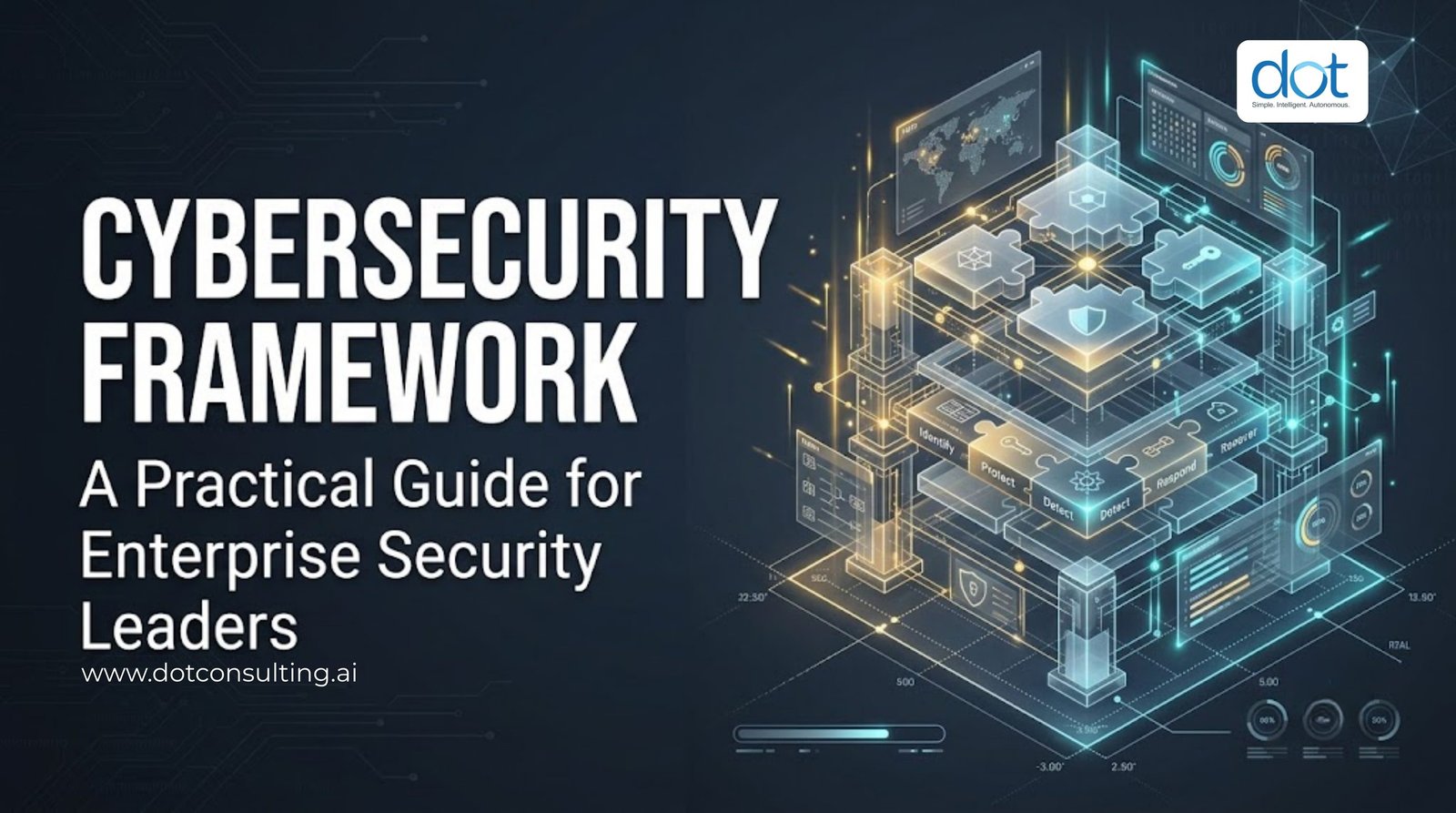
Cybersecurity Framework: A Practical Guide for Enterprise Security Leaders

Cyber threats are no longer limited to data breaches or malware attacks. Enterprises face growing risks from ransomware, cloud vulnerabilities, identity theft, supply chain attacks, and increasingly sophisticated cybercriminals. Managing these risks requires more than individual security tools. Organizations need a structured approach that connects cybersecurity practices with business objectives.

A cybersecurity framework provides that structure. It helps organizations identify risks, implement appropriate security controls, respond to incidents, and continuously improve their security posture. For enterprise security leaders, choosing and implementing the right framework is an important step toward building a resilient business.

What Is a Cybersecurity Framework?

A cybersecurity framework is a structured set of guidelines, practices, and recommendations that organizations use to manage cybersecurity risks. It establishes a consistent approach to protecting digital assets, sensitive information, networks, applications, and business operations.

Rather than prescribing a single security solution, a framework helps organizations understand their current security posture, identify gaps, prioritize improvements, and measure progress.

Popular frameworks include the NIST Cybersecurity Framework (CSF), ISO/IEC 27001, and the CIS Critical Security Controls. Each offers a different approach, depending on an organization’s size, industry, regulatory requirements, and security objectives.

Why Do Enterprises Need a Cybersecurity Framework?

As enterprises expand their digital operations, their attack surfaces grow. Cloud adoption, remote work, third-party integrations, and interconnected systems introduce new vulnerabilities that can be difficult to manage without a consistent strategy.

Implementing a cybersecurity framework helps organizations:

  • Identify and prioritize cybersecurity risks.
  • Establish consistent security policies and controls.
  • Improve incident detection and response.
  • Support regulatory compliance and audit readiness.
  • Strengthen accountability across teams.
  • Align cybersecurity investments with business priorities.

A framework also helps leadership understand cybersecurity in business terms, making it easier to evaluate risks and allocate resources effectively.

Popular Cybersecurity Frameworks Enterprises Should Know

Choosing the right framework depends on the organization’s operational requirements and risk profile.

1. NIST Cybersecurity Framework

Developed by the US National Institute of Standards and Technology, the NIST Cybersecurity Framework 2.0 provides guidance for managing cybersecurity risks across organizations of different sizes and industries.

Its six core functions are Govern, Identify, Protect, Detect, Respond, and Recover.

These functions help organizations establish accountability, understand their assets and risks, implement safeguards, detect threats, manage incidents, and restore operations after disruptions.

NIST CSF 2.0 is particularly useful for enterprises seeking a flexible, risk-based approach to cybersecurity.

2. ISO/IEC 27001

ISO/IEC 27001 is an international standard for establishing, implementing, maintaining, and continually improving an Information Security Management System (ISMS).

It takes a systematic approach to managing information security risks through policies, processes, controls, and ongoing evaluation.

Organizations pursuing formal certification can use ISO/IEC 27001 to demonstrate that their information security management system meets the standard’s requirements.

3. CIS Critical Security Controls

The CIS Critical Security Controls provide prioritized safeguards that organizations can implement to defend against common cyber threats.

They cover areas such as asset management, access control, vulnerability management, secure configuration, audit logging, and incident response.

These controls can be especially useful for organizations looking for practical security improvements and a prioritized implementation roadmap.

How to Implement a Cybersecurity Framework

Selecting a framework is only the first step. Successful implementation requires planning, ownership, and continuous evaluation.

Step 1: Assess Your Current Security Posture

Begin by evaluating existing security policies, technologies, processes, and controls. Identify critical assets, sensitive data, regulatory obligations, and potential vulnerabilities.

A gap assessment helps determine where current practices fall short of the chosen framework’s requirements.

Step 2: Identify and Prioritize Risks

Not every cybersecurity risk requires the same level of attention. Evaluate risks based on their likelihood, potential business impact, and the criticality of affected systems.

Prioritize threats that could disrupt essential operations, expose sensitive information, or create significant financial and reputational damage.

Step 3: Define Security Policies and Controls

Establish clear policies for access management, data protection, vulnerability management, incident response, employee awareness, and third-party security.

Select controls based on identified risks rather than implementing every available security measure without considering its business value.

Step 4: Assign Responsibilities

Cybersecurity is not exclusively an IT responsibility. Leadership, security teams, legal departments, compliance professionals, employees, and external vendors all have roles to play.

Define ownership for security decisions, risk acceptance, incident escalation, and compliance reporting.

Step 5: Monitor, Test, and Improve

Cyber risks change as technologies, business operations, and attack methods evolve. Regular vulnerability assessments, security testing, incident simulations, audits, and performance reviews help identify weaknesses.

Continuous monitoring also allows organizations to detect suspicious activity and respond to emerging threats more effectively.

Common Challenges in Framework Implementation

Enterprises may encounter challenges such as limited budgets, skills shortages, complex legacy systems, unclear ownership, and resistance to organizational change.

Another common mistake is treating framework implementation as a one-time compliance exercise. Documentation alone cannot protect an organization if security controls are poorly implemented or rarely tested.

To overcome these challenges, enterprises should adopt a phased implementation plan, assign clear responsibilities, prioritize high-impact risks, and regularly evaluate control effectiveness.

How Cybersecurity Consulting Services Can Help

Implementing a cybersecurity framework requires technical expertise, risk assessment capabilities, and an understanding of business requirements. Organizations may benefit from external specialists when internal resources are limited or when an independent assessment is needed.

Cybersecurity consultants can help evaluate existing controls, identify security gaps, recommend suitable frameworks, develop implementation roadmaps, and strengthen incident response processes.

They can also support governance improvements, compliance readiness, third-party risk assessments, and continuous security monitoring.

The goal is to establish a practical, sustainable security program that reduces risk while supporting business growth.

Conclusion

A well-implemented cybersecurity framework gives enterprises a structured way to manage cyber risks, strengthen security controls, and improve organizational resilience. By selecting an appropriate framework, assessing risks, defining responsibilities, and continuously monitoring performance, organizations can move beyond reactive security practices.

For enterprise leaders, the priority should be to treat cybersecurity as an ongoing business function rather than a one-time technical project. A proactive, risk-based approach helps protect critical assets, maintain stakeholder trust, and prepare the organization for evolving threats.

Frequently Asked Questions

1. What is the purpose of a cybersecurity framework?

Its purpose is to provide structured guidance for identifying, assessing, managing, and monitoring cybersecurity risks while improving an organization’s overall security posture.

2. Which cybersecurity framework is best for enterprises?

The right choice depends on business objectives and requirements. NIST CSF offers flexible risk management guidance, ISO/IEC 27001 supports an information security management system, and CIS Controls provide prioritized technical safeguards.

3. Is a cybersecurity framework mandatory?

Not universally. However, specific industries, contracts, regulations, or customer requirements may make particular standards or controls necessary.

4. How often should a cybersecurity framework be reviewed?

Organizations should review their security practices regularly and reassess them whenever significant changes occur in technology, business operations, regulations, or the threat landscape.

5. Can small and medium-sized businesses use cybersecurity frameworks?

Yes. Frameworks can be adapted to an organization’s size, resources, risk exposure, and operational complexity. Businesses can begin with essential controls and expand their security programs over time.

Enterprise Cyber Risk Management: From Risk Identification to Continuous Monitoring

Cyber threats are becoming more sophisticated, frequent, and difficult to predict. For modern enterprises, protecting data and systems is no longer limited to installing security tools or responding to incidents after they happen. Organizations need a structured approach that helps them identify vulnerabilities, assess potential threats, reduce exposure, and continuously monitor their security environment.

This is where cyber risk management becomes essential. It provides enterprises with a systematic framework to understand their cyber risks and make informed decisions about security, compliance, technology, and business continuity.

What Is Enterprise Cyber Risk Management?

Cyber risk management is the process of identifying, evaluating, prioritizing, and managing cybersecurity risks that could affect an organization’s operations, data, technology, finances, or reputation.

For enterprises, cyber risk extends beyond internal IT infrastructure. Cloud platforms, remote employees, third-party vendors, applications, connected devices, and digital services can all introduce potential vulnerabilities.

An effective approach connects cybersecurity with business objectives. Instead of treating every vulnerability as equally important, organizations can prioritize risks based on their likelihood, potential impact, and relevance to critical business operations.

Step 1: Identify Cyber Risks

The first stage of effective cyber risk management is understanding what needs to be protected and where risks may exist.

Enterprises should maintain visibility across their digital environment, including:

  • Critical applications and infrastructure
  • Sensitive and regulated data
  • Cloud environments
  • Endpoints and connected devices
  • Third-party and supply chain systems
  • User identities and access privileges
  • Business-critical processes

Risk identification should also consider common threats such as ransomware, phishing, insider threats, credential theft, data breaches, and supply chain attacks.

Without an accurate view of the organization’s assets and dependencies, security teams may overlook important vulnerabilities.

Step 2: Assess and Prioritize Risks

Identifying risks is only the beginning. Enterprises need to determine which risks require immediate attention.

Risk assessment typically considers factors such as the likelihood of an attack, the value of the affected asset, existing security controls, potential financial losses, regulatory consequences, and operational disruption.

For example, a vulnerability affecting a public-facing system containing sensitive customer information may represent a significantly higher risk than a similar vulnerability affecting a non-critical internal application.

Risk prioritization helps security teams focus resources where they can deliver the greatest reduction in exposure.

Step 3: Develop a Risk Treatment Strategy

Once risks have been prioritized, organizations need to determine how each risk should be handled.

Common approaches include:

Mitigate: Implement security controls to reduce the likelihood or impact of the risk.

Avoid: Change a process, system, or activity to eliminate the risk.

Transfer: Shift part of the financial or operational impact through insurance, contracts, or third-party arrangements.

Accept: Recognize the risk when reducing it further would not be practical or proportionate to the potential impact.

A strong risk treatment strategy should align cybersecurity decisions with business priorities rather than relying solely on technical considerations.

Step 4: Strengthen Security Controls

Risk reduction requires appropriate security controls. Depending on the organization’s environment, these may include identity and access management, multi-factor authentication, encryption, endpoint protection, vulnerability management, network security, security awareness training, and data protection.

Enterprises should also regularly evaluate whether existing controls are effective. A security control that worked several years ago may no longer provide sufficient protection against today’s threat landscape.

Security frameworks and standards can provide useful structures for developing and evaluating these controls.

Step 5: Manage Third-Party Cyber Risk

Modern enterprises often depend on vendors, cloud providers, technology partners, and other external organizations. This creates another layer of cyber risk.

A compromised third party can potentially provide attackers with access to sensitive information or critical systems.

Third-party cyber risk management should therefore include vendor assessments, security requirements in contracts, access controls, ongoing monitoring, compliance reviews, and incident response expectations.

Organizations should not assess vendors only when contracts are signed. Their security posture can change over time, making continuous evaluation important.

Step 6: Implement Continuous Monitoring

Cyber risk is not static. New vulnerabilities emerge, employees change roles, systems are updated, vendors are introduced, and threat actors constantly change their methods.

Continuous monitoring helps enterprises identify changes that could increase their exposure.

Security teams can monitor vulnerabilities, suspicious activity, access patterns, endpoint events, cloud environments, threat intelligence, and third-party risks. Security information and event management (SIEM), extended detection and response (XDR), vulnerability management platforms, and automated alerts can support this process.

The objective is not simply to collect more security data. It is to turn relevant information into actionable intelligence.

Step 7: Measure and Improve

Effective cyber risk management requires regular measurement and improvement.

Enterprises can track metrics such as:

  • Number of critical vulnerabilities
  • Average time to detect and respond to incidents
  • Patch management performance
  • Third-party risk exposure
  • Security control effectiveness
  • Compliance gaps
  • Incident frequency and impact

These metrics help security and business leaders understand whether their risk posture is improving.

Regular assessments, penetration testing, security audits, tabletop exercises, and incident reviews can also reveal weaknesses that require attention.

Why Cyber Risk Management Matters for Enterprises

Cybersecurity incidents can affect far more than an organization’s IT department. A major breach can interrupt operations, expose confidential information, damage customer trust, create regulatory consequences, and result in significant financial losses.

A mature approach to cyber risk management allows enterprises to move from reactive security to proactive risk reduction. It helps organizations understand their exposure, prioritize investments, strengthen resilience, and respond more effectively when threats emerge.

Most importantly, it creates a common language between cybersecurity teams and business leadership. Security decisions can be connected directly to business risks and objectives.

Conclusion

Enterprise cybersecurity requires more than responding to threats after they occur. Organizations need an ongoing process that begins with identifying risks and continues through assessment, prioritization, mitigation, monitoring, and improvement.

By adopting a structured cyber risk management approach, enterprises can gain greater visibility into their security posture, reduce unnecessary exposure, and build stronger resilience against evolving cyber threats.

For organizations looking to strengthen their cybersecurity strategy, working with experienced cybersecurity consultants can provide the expertise, assessment capabilities, and strategic direction needed to build a more resilient security environment.

Frequently Asked Questions

1. What is cyber risk management?

Cyber risk management is the process of identifying, assessing, prioritizing, treating, and continuously monitoring cybersecurity risks that could affect an organization’s systems, data, operations, and reputation.

2. Why is cyber risk management important for enterprises?

It helps enterprises understand their cybersecurity exposure, prioritize critical risks, allocate security resources effectively, and reduce the potential impact of cyber incidents.

3. What are the main steps in cyber risk management?

The main steps include risk identification, assessment, prioritization, treatment, implementation of security controls, continuous monitoring, measurement, and ongoing improvement.

4. How does continuous monitoring help?

Continuous monitoring allows organizations to detect new vulnerabilities, suspicious activities, configuration changes, and emerging threats before they develop into major security incidents.

5. Should third-party vendors be included in cyber risk management?

Yes. Vendors and technology partners can introduce significant security risks. Organizations should assess third-party security practices and monitor vendor risks throughout the relationship.

6. How can enterprises improve their cyber risk management strategy?

Enterprises can improve their strategy through regular risk assessments, stronger security controls, continuous monitoring, employee awareness, third-party risk management, security testing, and ongoing improvement.

Cybersecurity Strategy for Enterprises: How to Build it in 2026

Cybersecurity has become a business priority, not simply an IT responsibility. As enterprises move more workloads to the cloud, adopt AI, support remote workforces, and connect increasingly complex digital environments, the attack surface continues to expand. At the same time, cyber threats are becoming more sophisticated, targeted, and difficult to detect.

For businesses entering 2026, having security tools in place is no longer enough. Organisations need a structured enterprise cybersecurity strategy that connects technology, people, processes, risk management, and business objectives.

A strong strategy helps enterprises identify their most critical risks, strengthen their security posture, respond to incidents effectively, and build resilience against evolving threats. Here is how organisations can build an effective cybersecurity strategy for 2026.

1. Start with a cybersecurity risk assessment

Before investing in new security technologies, enterprises need to understand their current risk exposure. Assess critical applications, infrastructure, cloud environments, endpoints, networks, data, and third-party connections.

Identify vulnerabilities and determine which assets would have the greatest business impact if compromised. This helps security teams prioritise investments based on actual business risk.

2. Strengthen identity and access management

Stolen credentials remain a major security risk. Enterprises should strengthen identity security using multi-factor authentication, privileged access management, role-based access controls, and strong password policies.

A Zero Trust approach can add another layer of protection by continuously verifying users, devices, and access requests rather than automatically trusting users within the corporate network.

3. Secure cloud and hybrid environments

Cloud adoption has transformed enterprise IT environments. Many organisations now operate across public cloud platforms, private infrastructure, SaaS applications, and hybrid environments.

This complexity can create security gaps when responsibilities, configurations, and access controls are not properly managed.

An effective enterprise cybersecurity strategy should therefore include cloud security from the beginning. Organisations should establish secure configuration standards, monitor cloud activity, protect cloud identities, encrypt sensitive data, and regularly review permissions.

Security teams should also understand the shared responsibility model associated with their cloud services and clearly define which security responsibilities belong to the organisation and which belong to the provider.

4. Protect sensitive business data

Customer information, financial records, intellectual property, and confidential business data are valuable targets for attackers.

Enterprises should identify sensitive information and understand where it is stored, processed, and accessed. Data classification, encryption, access controls, secure backups, and data loss prevention can help reduce exposure.

5. Address AI-related security risks

AI is becoming part of everyday enterprise operations, but it introduces new security challenges. Employees may unknowingly share confidential information with AI tools, while attackers can use AI to create more convincing phishing campaigns and automate attacks.

Organisations should establish clear AI usage policies, protect sensitive information, assess AI applications before deployment, and provide employees with appropriate security guidance.

6. Improve threat detection and incident response

Prevention alone cannot stop every cyberattack. Enterprises need the ability to identify suspicious activity quickly and respond before an incident causes significant damage.

Security monitoring should cover endpoints, networks, cloud environments, applications, identities, and critical infrastructure. Security Information and Event Management (SIEM), Extended Detection and Response (XDR), and automated security tools can help security teams identify threats more efficiently.

However, technology is only one part of the equation. Organisations also need clearly defined incident response procedures, escalation paths, communication plans, and recovery processes.

Regular simulations and tabletop exercises can help teams understand what to do when a real incident occurs.

7. Manage third-party cybersecurity risks

Vendors, contractors, cloud providers, and business partners can introduce additional security risks. A strong cybersecurity strategy should therefore include third-party risk management.

Organisations should assess vendors before onboarding them and regularly review their security practices. Contracts should also define data protection requirements, security responsibilities, and breach notification procedures.

8. Build a security-aware workforce

Employees are an important part of an organisation’s security posture. Phishing, social engineering, weak passwords, and accidental data exposure can create significant vulnerabilities.

Regular security awareness training should cover phishing, password security, data protection, device security, and responsible AI usage. Simulated phishing exercises can also help employees recognise common attack techniques.

9. Measure and continuously improve security

An effective cybersecurity strategy needs measurable goals. Security leaders can track metrics such as vulnerability remediation times, incident response times, phishing simulation results, privileged account coverage, and security awareness participation.

Cybersecurity should be treated as an ongoing process rather than a one-time project. Regular reviews allow organisations to adapt to emerging threats, technology changes, regulatory requirements, and new business risks.

Build a stronger cybersecurity strategy with DOT Consulting

A resilient cybersecurity programme requires more than individual security products. Enterprises need a clear strategy that connects risk management, technology, compliance, people, and business objectives.

DOT Consulting helps organisations strengthen their cybersecurity posture through practical, business-focused security guidance. From identifying vulnerabilities and assessing risks to improving security architecture and building stronger protection frameworks, the right cybersecurity approach can help enterprises prepare for the threats of 2026 and beyond.

Ready to strengthen your enterprise cybersecurity strategy? Partner with DOT Consulting to build a security approach designed around your organisation’s risks, priorities, and future growth.

Frequently Asked Questions

What is an enterprise cybersecurity strategy?

It is a structured approach to protecting an organisation’s systems, data, applications, people, and infrastructure from cyber threats while aligning security with business objectives.

Why is cybersecurity strategy important in 2026?

Cloud adoption, AI, remote work, and increasingly sophisticated attacks are expanding enterprise risk. A strong strategy helps organisations protect critical assets and improve resilience.

What should an enterprise cybersecurity strategy include?

It should cover risk assessment, identity security, cloud security, data protection, threat detection, incident response, third-party risk, employee awareness, and continuous monitoring.

How can businesses manage AI-related cybersecurity risks?

Businesses should establish AI usage policies, protect confidential information, assess AI applications, monitor emerging risks, and train employees on secure AI practices.

How often should a cybersecurity strategy be reviewed?

It should be reviewed regularly and whenever there are major technology changes, security incidents, regulatory updates, or significant changes to the organisation’s risk environment.

Cybersecurity Consulting Services: A Complete Guide for Enterprise Security Leaders

Cybersecurity has moved from being an IT concern to a core business priority. Enterprises today operate across cloud platforms, connected applications, remote workforces, third-party ecosystems and increasingly AI-enabled environments. For security leaders, the challenge is understanding risk exposure, protecting critical assets, meeting regulatory expectations and keeping the business operating when an incident occurs.

This is where cybersecurity consulting services can help enterprises move from fragmented security efforts to a more strategic and resilient approach.

Why enterprises need a broader cybersecurity strategy

Traditional cybersecurity often focused on protecting a clearly defined perimeter. Firewalls, endpoint protection, antivirus software and access controls were central to the model.

Data can move between internal systems, cloud platforms, SaaS applications, suppliers and employee devices. Digital services may depend on several external providers. AI tools can access or process business information. Employees can connect to corporate resources from almost anywhere.

As the digital environment expands, security cannot be treated as a collection of isolated controls. Enterprises need visibility across the entire technology ecosystem and an understanding of how individual risks can affect business operations.

Cybersecurity consulting services help bring these elements together by connecting security strategy with business priorities across the enterprise.

What do cybersecurity consulting services cover?

A consulting engagement can address several areas of enterprise security.

1. Cybersecurity risk assessment

Before improving security, organisations need to understand their current position.

A risk assessment examines infrastructure, applications, identities, data, cloud environments, third-party connections and existing security controls. It can identify vulnerabilities, control gaps and areas where a security incident could have significant operational or financial consequences.

The value lies in prioritisation. Not every vulnerability carries the same business risk. Security leaders need to know which issues require immediate attention and which can follow a longer-term roadmap.

2. Security strategy and roadmap

Security investments need to support the direction of the business.

A cybersecurity strategy establishes priorities, responsibilities, security objectives and a practical roadmap for improvement. It can help organisations align people, processes and technology instead of adding security tools without a clear operating model.

A strong roadmap should remain adaptable as applications, regulations, business models and technologies change.

3. Cloud and infrastructure security

Cloud adoption has changed how organisations approach infrastructure security.

Hybrid and multi-cloud environments can create challenges around configuration, access, identity, data protection and visibility. A consulting partner can assess these environments and help establish consistent security controls across different platforms.

The objective is to create a security architecture that supports scalability while maintaining appropriate protection and governance.

4. Identity and access management

Identity has become one of the most important components of enterprise security.

Employees, contractors, partners, applications and automated systems may all require access to business resources. Excessive privileges, inactive accounts or weak authentication can increase exposure.

Cybersecurity consulting services can strengthen identity governance, authentication, privileged access and access reviews. Every user and system should have only the access required for its role.

5. Third-party and supply chain security

An organisation’s security posture does not stop at its own network.

Suppliers, technology partners, contractors and SaaS providers may have access to systems or sensitive information. A weakness within one of these relationships can create risk for the wider enterprise.

Third-party risk management can include vendor assessments, security requirements, risk classification, monitoring and governance. This gives security leaders greater visibility into the extended ecosystem.

6. AI security and governance

AI is introducing a new dimension to enterprise cybersecurity.

Organisations are using AI for analysis, automation, customer service, software development and decision support. At the same time, employees may adopt external AI tools without security teams having complete visibility into how enterprise information is being used.

AI security therefore needs to address data exposure, access, privacy, model risks, third-party dependencies and responsible use.

A consulting-led approach can establish AI governance around approved tools, data handling, access controls, monitoring and security assessments.

7. Security operations and incident response

Prevention alone cannot eliminate cyber risk.

Enterprises need the ability to detect suspicious activity, investigate incidents, contain threats and recover quickly. This requires effective monitoring, threat detection, intelligence and response processes.

Incident response planning is equally important. Security leaders should know who makes decisions, how incidents are escalated, which systems receive recovery priority and how communication is managed.

The goal is to reduce the distance between detection and recovery.

8. Compliance and cyber resilience

Regulatory requirements are becoming increasingly important as enterprises operate across markets and industries.

However, compliance should not become a separate exercise performed only before an audit. Security controls, governance, risk management and regulatory requirements should work together.

This supports a broader goal: cyber resilience.

A resilient organisation can prepare for disruption, detect threats, respond effectively, recover critical operations and learn from incidents. Cybersecurity becomes part of business continuity rather than remaining isolated within IT.

Choosing the right cybersecurity consulting partner

Enterprise security leaders should evaluate consulting partners beyond their technical capabilities.

A strong partner should understand the relationship between cybersecurity, technology, risk and business operations. The engagement should provide a clear view of the current security posture, prioritised recommendations and a practical path towards improvement.

They should also consider support for cloud security, AI governance, third-party risk and continuous improvement.

From reactive protection to strategic resilience

Modern enterprises do not necessarily need more security tools. They need greater clarity about their risks and how their security capabilities work together.

Cybersecurity consulting services can help organisations move from reactive protection to strategic resilience by connecting assessment, governance, technology, compliance, monitoring and response.

As enterprises continue adopting AI, expanding digital ecosystems and moving critical workloads to cloud environments, cybersecurity must evolve alongside the business.

The objective is not to make risk disappear. It is to build an organisation that understands its exposure, protects what matters most, responds effectively and continues operating through disruption.

For today’s enterprise security leaders, cybersecurity is no longer simply about defending systems. It is about creating the visibility, governance and resilience needed to support sustainable digital growth.

Build a More Resilient Security Strategy with DOT Consulting

Your security strategy should evolve as quickly as your business does.

Whether you are assessing your current security posture, strengthening cloud environments, preparing for compliance, managing emerging AI risks or building a more proactive security operating model, DOT can help turn cybersecurity priorities into measurable enterprise outcomes.

Ready to understand where your organisation stands? Start with a cybersecurity readiness assessment with DOT Consulting and identify the risks, gaps and priorities that matter most to your business.

Build security that evolves with your business. Connect with DOT Consulting today.

Cyber threat intelligence types and lifecycle – cybersecurity services by DOT Consulting

What Is Cyber Threat Intelligence? Types, Lifecycle and Business Value

Cyber threat intelligence types and lifecycle – cybersecurity services by DOT Consulting

Raw threat data is not intelligence. A feed containing millions of malicious IP addresses and file hashes tells you what exists across the global internet, but it fails to tell you what actually matters to your specific organization or what steps you should take next. Engaging specialized cyber security consulting services helps organizations transform unrefined indicators into decision-ready context. This guide explores the definition of cyber threat intelligence, examines its four primary types and six-stage lifecycle, and demonstrates how it delivers tangible business value for modern enterprise leadership.

What Is Cyber Threat Intelligence?

Cyber threat intelligence is evidence-based knowledge, including context, mechanisms, indicators, implications, and actionable advice, about an existing or emerging hazard to assets. It empowers organizations to make informed, timely security decisions.

Raw security data transforms into actionable intelligence through a structured progression:

  1. Data: Unstructured indicators such as raw logs, IP addresses, or file hashes.
  2. Information: Aggregated data organized into recognizable patterns, such as a cluster of failed login attempts from a specific IP subnet.
  3. Intelligence: Contextualized information evaluated for relevance, intent, and impact against your specific infrastructure, producing an actionable defense recommendation.

To deliver real value, intelligence must pass three critical tests: it must be relevant to your digital footprint, timely enough to enable proactive defense, and actionable for your security teams. Without these filters, enterprise security operations drown in noisy feeds without reducing actual risk.

The Four Types of Threat Intelligence

Strategic Intelligence

Targeted at board members and C-suite executives, strategic intelligence analyzes high-level threat landscape trends, geopolitical shifts, and sector-specific risks. It delivers non-technical risk evaluations that inform security budgets, executive risk appetite, and long-term security investments.

Tactical Intelligence

Designed for security architects and system administrators, tactical intelligence outlines specific attacker tactics, techniques, and procedures (TTPs). By mapping adversary behavior to frameworks like MITRE ATT&CK, it guides defensive control design, threat hunting, and infrastructure hardening.

Operational Intelligence

Focused on incident response teams and security managers, operational intelligence provides context about specific cybercrime campaigns and threat actors targeting your industry. It details adversary intent, capabilities, and timing to help teams anticipate and intercept active attacks.

Technical Intelligence

Consumed directly by SOC analysts and automated security tooling, technical intelligence consists of tactical Indicators of Compromise (IOCs)—such as malicious URLs, IP addresses, and malware hashes. Characterized by high volume and a short shelf life, it drives real-time automated blocking.

The 9 Pillars of Preemptive External Threat Intelligence

Modern threat landscape management integrates nine specialized operational pillars to deliver continuous, adversary-centric visibility across the external attack surface:

  1. Attack Surface Discovery & Intelligence: Maps and monitors the full IT/OT environment, uncovering hidden risks and critical attack paths.
  2. Vulnerability Intelligence & Threat Prioritization: Real-time detection and risk-based prioritization of weaknesses by correlating active exploitation trends with adversary intent.
  3. Brand & Online Exposure Management: Safeguards corporate trust, executive reputation, and digital footprints from impersonation, deepfakes, and fraud across open, deep, and dark web channels.
  4. Digital Risk & Identity Protection: Rapidly uncovers leaked credentials, data breaches, exposed source code, and targeted phishing or ransomware campaigns before harm occurs.
  5. Third-Party Risk Management (TPRM): Continuously assesses vendors, shared platforms, and supply-chain partners for inherited security weaknesses and breaches.
  6. Situational Awareness & Emerging Threats: Provides a highly contextual, real-time view of geopolitical and industry-specific threats tailored to your technology stack.
  7. Predictive Threat Intelligence: Delivers early-warning insights on threat actors, campaigns, and attack timelines targeting your organization well before incidents unfold.
  8. Threat Adaptive Awareness & Training: Turns employees into an active human-sensor layer through training programs built on live threat activity directed at your industry.
  9. Sector-Tailored Deception Intelligence: Deploys customized, high-interaction decoys that attract adversaries and convert interactions into precise, early-stage intelligence.

The Threat Intelligence Lifecycle

The threat intelligence lifecycle is a continuous six-stage process that transforms raw data into actionable security insights:

  1. Direction: Define clear intelligence requirements based on your business priorities, crown-jewel assets, and specific risk profile.
  2. Collection: Gather raw security data from internal telemetry, commercial feeds, OSINT, sector ISACs, and specialized Dark Web Monitoring.
  3. Processing: Structure, normalize, deduplicate, and enrich raw data feeds into usable, standardized formats.
  4. Analysis: Evaluate processed information for credibility, relevance, and severity, leveraging AI in Cybersecurity for automated correlation.
  5. Dissemination: Deliver finished intelligence to the right stakeholders—from CISO executive dashboards to SIEM rules, in appropriate formats.
  6. Feedback: Measure the operational impact of disseminated intelligence and refine future requirements based on leadership decisions.

Most enterprise intelligence programs fail at stages 1 and 6 by collecting data without clear direction or feedback. A comprehensive cybersecurity risk assessment establishes this direction, ensuring requirements align strictly with asset criticality and real exposure.

The Business Value of Threat Intelligence

Deploying contextual threat intelligence delivers measurable business outcomes beyond tactical security metrics:

  • Faster Incident Response: Pre-enriched context accelerates root-cause analysis, significantly reducing Mean Time to Detect (MTTD) and Mean Time to Respond (MTTR).
  • Sharper Risk Decisions: Integrating real-world threat actor activity into your cybersecurity risk assessment replaces static annual assumptions with dynamic, evidence-based risk scoring.
  • Optimized Security Spend: Focus defensive controls and security budgets on active threats targeting your specific industry rather than chasing generic compliance checklists.
  • Supply Chain Visibility: Early warning indicators highlight third-party vendor compromises, strengthening your overall Vendor Risk Management posture.
  • Board-Level Clarity: Translates complex technical telemetry into actionable business risk language for executive oversight.

Maximizing this business value requires experienced cyber risk consulting to synthesize complex threat feeds into strategic operational improvements.

Building vs. Buying Threat Intelligence Capability

Establishing an internal threat intelligence unit requires substantial capital, specialized analysts, advanced platform orchestration, and 24/7 operational coverage, an investment that is often impractical for mid-market enterprises. Conversely, relying solely on commercial data feeds creates feed overload without delivering organization-specific context.

Most forward-looking organizations adopt a hybrid model: retaining internal ownership of business priorities and response actions while partnering with cyber risk consulting advisors for threat collection, deep-dive analysis, and contextual filtering.

Professional cyber security consulting services bridge this capability gap. By helping organizations define intelligence requirements, select vendor-neutral threat feeds, build dissemination workflows, and integrate intelligence directly into existing SOC operations, cyber security consulting services ensure your security investments drive concrete risk reduction.

Conclusion

Cyber threat intelligence is only as valuable as the security decisions it changes. By moving beyond raw indicator feeds and implementing a structured lifecycle across all 9 operational pillars, enterprise leaders can transform security from a reactive burden into a proactive business enabler. 

Ready to enhance your threat visibility? Partnering with expert cyber security consulting services allows you to schedule a comprehensive cybersecurity risk assessment on our Cybersecurity Services page to identify your critical exposures and build a tailored defense strategy.

Frequently Asked Questions

1. What is the difference between threat data and threat intelligence?

Threat data consists of unrefined indicators like IP addresses and malware hashes. Intelligence is that data analyzed within context to support specific security decisions.

2. What are the four types of cyber threat intelligence?

The four types are strategic, tactical, operational, and technical, each tailored to distinct organizational roles, ranging from executive boards to SOC tooling.

3. How does threat intelligence support a cybersecurity risk assessment?

It replaces generic risk assumptions with real-world threat actor data, ensuring your cybersecurity risk assessment reflects active threats targeting your specific industry.

4. Do mid-sized companies need threat intelligence?

Yes. Mid-sized enterprises access actionable threat intelligence through managed security partners or cyber risk consulting services, gaining expert analysis without building a dedicated team.

Enterprise cyber risk management from risk identification to continuous monitoring – DOT Consulting

Enterprise Cybersecurity Consulting- Beyond Traditional Security for Modern Enterprises

Enterprise cyber risk management from risk identification to continuous monitoring – DOT Consulting

Cybersecurity is no longer just an IT responsibility. As enterprises become more connected, cloud-dependent and AI-enabled, traditional security approaches are being tested by a threat landscape changing faster than many organisations can adapt.

The challenge is no longer simply preventing an attack. Enterprises need to understand where their exposure lies, how risks could affect business operations, and how quickly they can detect, respond to and recover from disruption.

This is where enterprise cybersecurity consulting becomes increasingly important.

Why traditional cybersecurity is no longer enough

Traditional security strategies often focus on protecting defined perimeters through firewalls, antivirus software, endpoint protection and access controls. But the modern enterprise has very few fixed boundaries.

Employees work across locations. Applications run across hybrid and multi-cloud environments. Data moves between systems, partners and third-party platforms. AI tools are entering everyday workflows.

The result is a larger and more interconnected attack surface.

The World Economic Forum’s Global Cybersecurity Outlook 2025 found that 54% of large organisations identified supply chain challenges as the biggest barrier to achieving cyber resilience. It also found that while 66% expected AI to have a major impact on cybersecurity, only 37% had processes to assess AI tools before deployment.

Cybersecurity has become a business resilience issue

A cybersecurity incident rarely stays within the security department.

A compromised system can interrupt operations. Ransomware can stop critical processes. A data breach can create regulatory exposure. A compromised supplier can provide attackers with an indirect route into the organisation.

The financial impact can also be substantial. IBM’s 2025 Cost of a Data Breach Report found that the global average cost of a data breach was US$4.44 million. It also reported that 97% of organisations experiencing an AI-related security incident lacked proper AI access controls.

This changes the question enterprises need to ask.

Instead of asking, “Do we have enough security tools?”, the more relevant question is, “Can our organisation anticipate, withstand and recover from cyber disruption?”

What modern enterprise cybersecurity needs to address

1. A risk-based security strategy

Every organisation has different systems, data, processes and risk exposures. A standard checklist cannot provide the same protection across every enterprise.

Enterprise cybersecurity consulting begins with understanding the organisation’s risk environment. This includes critical applications, sensitive data, identity and access management, cloud infrastructure, third-party relationships, AI systems, regulatory requirements and business continuity.

The objective is to identify weaknesses that could create the greatest business impact and prioritise investment.

2. Security across the extended enterprise

An organisation’s cybersecurity posture is increasingly influenced by companies outside its direct control.

Suppliers, technology partners, contractors and SaaS providers can introduce vulnerabilities. This makes third-party risk management an important component of modern cybersecurity.

A strong consulting approach should look beyond internal infrastructure and examine the wider ecosystem. As supply chains become more interconnected, supplier visibility becomes increasingly important.

3. AI security and governance

AI is creating a new cybersecurity equation.

Organisations are adopting AI to improve productivity, automate processes and support decision-making. At the same time, employees may use external AI tools without security teams having visibility into what information is being shared.

AI systems can also introduce risks involving access, data exposure, model vulnerabilities and third-party dependencies.

This means AI security and governance need to become part of the broader enterprise cybersecurity strategy.

Organisations need controls around approved AI tools, data sharing, access, monitoring and security assessment.

4. Continuous monitoring and threat detection

Prevention remains important, but no security strategy can guarantee that every threat will be stopped.

Modern cybersecurity needs strong detection and response capabilities. This means continuous monitoring, threat intelligence, automated detection and clearly defined incident response processes.

The objective is to reduce the time between threat, detection, containment and recovery, limiting operational and financial damage.

5. Compliance that goes beyond checklists

Regulatory compliance is another reason enterprises need an integrated cybersecurity strategy.

Organisations operating across multiple markets may need to navigate different privacy, cybersecurity and sector-specific requirements. The World Economic Forum has highlighted fragmented regulations across jurisdictions as a significant compliance challenge for security leaders.

Compliance should not be treated as a one-time audit exercise. A stronger approach connects regulatory requirements with security controls, risk management and business processes.

6. Cyber resilience, not just cyber defence

The objective of cybersecurity is not simply to build more barriers. It is to build an organisation that can continue operating when something goes wrong.

Cyber resilience brings together prevention, detection, response, recovery and continuous improvement.

This requires organisations to understand which systems are critical, how quickly they need to be restored, which processes depend on them, how incidents should be escalated and who makes critical decisions during an incident.

What should enterprises look for in a cybersecurity consulting partner?

Technology alone cannot solve every cybersecurity challenge.

A modern enterprise cybersecurity consulting partner should connect technology, risk, governance and business objectives.

The right approach should help organisations assess their security posture, prioritise business-critical risks, design a practical cybersecurity roadmap, implement controls across infrastructure and data, monitor threats, govern AI and improve continuously as risks evolve.

Moving from security tools to security strategy

Modern enterprises do not necessarily need more cybersecurity tools. They need greater visibility into how those tools, processes and controls work together.

A fragmented security environment can create blind spots even when an organisation has invested heavily in technology.

Enterprise cybersecurity consulting helps bring these elements together into a cohesive strategy, connecting risk, security, governance, technology and business continuity.

As enterprises adopt AI, expand digital ecosystems and depend increasingly on interconnected technology, cybersecurity needs to evolve alongside them.

The future of enterprise security will not be defined by how many tools an organisation deploys. It will be defined by how effectively it can understand risk, protect critical assets, respond to threats and remain resilient in an increasingly complex digital environment.

For modern enterprises, cybersecurity is no longer simply about defending the perimeter. It is about building the resilience to operate confidently beyond it for long-term enterprise resilience today.

AI in cybersecurity services for enterprise leaders – DOT Consulting

AI in Cybersecurity: The Complete Guide for Enterprise Leaders

AI in cybersecurity services for enterprise leaders – DOT Consulting

Enterprise security operates under a severe structural imbalance: threat actors use automated script loops and generative models to launch targeted campaigns at negligible cost, while internal security teams remain tethered to rule-based tools and manual triage. Artificial intelligence changes this baseline by moving defense from reactive filtering to predictive execution. However, machine learning is neither a silver bullet nor a self-managing strategy. Successfully scaling machine intelligence across complex corporate environments requires seasoned cyber security consulting services to ensure these platforms reduce exposure rather than create hidden operational risk.

Why Traditional Enterprise Cybersecurity Is Falling Behind

Modern security operations centers (SOCs) face an operational ceiling. Traditional enterprise cybersecurity platforms rely heavily on static signatures and pre-configured correlation rules. These systems work well against known threats, but fail when confronted with polymorphic malware, credential stuffing, and novel zero-day exploits.

Compounding this challenge is the rapid expansion of the corporate attack surface. Cloud migrations, multi-SaaS environments, remote workforces, and third-party API integrations generate billions of daily telemetry events. Human analysts simply cannot process this volume, leading to severe alert fatigue and missed signals. Meanwhile, attacker-side automation has compressed dwell times from weeks to minutes. Automated phishing engines create hyper-personalized lure campaigns in seconds, bypassing conventional email filters. Address this capability gap, rather than throwing more budget at disjointed tools, to maintain operational resilience.

What AI Actually Does in Cybersecurity

Anomaly and Behavioural Detection

AI algorithms establish continuous baselines for normal user, device, and network behavior across your infrastructure. By analyzing multi-dimensional telemetry, these systems flag subtle deviations, such as unusual lateral movement or off-hours data staging, that static correlation rules consistently miss.

Automated Triage and Response

Machine learning models automatically enrich incoming alerts with contextual threat data, filter out noise, and assign risk scores. For routine, low-risk incidents, agentic workflows execute self-healing playbook responses like isolating endpoints or revoking compromised tokens, drastically reducing mean time to respond (MTTR).

Predictive Threat Intelligence

By correlating internal logs with global external feeds, predictive engines map active attacker tactics against your specific vulnerability footprint. Integrating advanced Cyber Threat Intelligence allows security teams to identify attack paths and patch critical exposures before adversaries actively exploit them.

Continuous Compliance Monitoring

AI framework engines continuously map infrastructure configurations against regulatory baselines like ISO 27001, SOC 2, and the NIST CSF. Instead of relying on annual point-in-time audits, these tools surface configuration drift and policy violations in real time, simplifying governance across hybrid environments.

The Risks AI Introduces

Deploying machine learning inside security architectures introduces unique vulnerabilities that demand strategic oversight. Model drift and excessive false positives can confuse security analysts, replacing traditional noise with complex, algorithmic alert fatigue.

Adversarial manipulation represents an even greater threat. Bad actors actively employ prompt injection, data poisoning to bypass detection models, and model extraction attacks to reverse-engineer defensive logic. Furthermore, the unmonitored adoption of generative tools, known as “Shadow AI”, frequently leaks sensitive corporate intellectual property into external environments without administrative oversight.

Without an established AI Governance Framework, organizations risk deploying automated systems faster than their security posture can handle. Navigating these trade-offs requires specialized cyber risk consulting to balance rapid automation against operational exposure.

Building an AI-Ready Security Programme

Transforming raw analytical capabilities into a defensible security posture requires a structured operational roadmap:

  1. Assess current maturity and data readiness: Audit your existing log quality, data pipelines, and infrastructure visibility to ensure models ingest clean telemetry.
  2. Define governance before deployment: Establish clear data ownership policies, acceptable use guidelines, and a complete inventory of all enterprise models.
  3. Start with a narrow, high-volume use case: Deploy automation initially for scoped tasks like phishing email triage or basic endpoint isolation.
  4. Keep humans in the loop: Retain human analyst oversight for high-impact decisions, such as shutting down production databases or isolating executive devices.
  5. Measure against outcomes: Evaluate success using core operational metrics like Mean Time to Detect (MTTD), MTTR, and asset coverage rather than total tool counts.

Navigating this five-step progression requires deep technical expertise. Independent cyber security consulting services help organizations conduct unbiased maturity assessments, select vendor-neutral technologies, and architect governance models that keep enterprise cybersecurity aligned with overall business goals. Leveraging specialized cyber security consulting services ensures your team builds sustainable capabilities without adding unnecessary vendor complexity.

Choosing the Right Cyber Security Consulting Partner

Selecting the right advisory partner is essential when integrating automation into defense operations. Evaluate potential advisory firms using these key criteria:

  • Vendor neutrality: Ensure the firm does not push proprietary software or reseller agreements, focusing instead on objective, architecture-first recommendations.
  • Jurisdictional regulatory depth: Verify their expertise in local and international data governance laws, including the DPDP Act, CERT-In guidelines, GDPR, and regional cybersecurity mandates.
  • Combined AI governance and security expertise: Look for proven experience across both advanced risk management and technical security architecture.
  • Collaborative operational model: Confirm their teams work alongside your in-house staff to build internal capabilities rather than creating external dependencies.
  • Demonstrable business outcomes: Prioritize partners with a record of measurable improvements in response speed and risk reduction over simple industry certifications.

Conclusion

Artificial intelligence is a powerful force multiplier for organizations that have established clear visibility and governance, and a dangerous liability for those that have not. Bringing structured automation into defense architectures requires clear alignment across people, process, and technology.

Ready to modernize your defense model safely? Schedule a consultation with our experts on our Cybersecurity Services page to assess your readiness and build an execution strategy tailored to your organization.

Frequently Asked Questions

What is AI in cybersecurity?

It is the application of machine learning algorithms to analyze telemetry, detect anomalies, automate routine alert triage, and predict threats faster than standard rule-based software allows.

Can AI replace a security team?

No. AI handles data scale and execution speed, but human analysts remain essential for business context, strategic threat hunting, and critical risk decisions. Most organizations pair internal teams with specialized cyber risk consulting guidance.

How do cyber security consulting services help with AI adoption?

Experienced advisors evaluate technical readiness, recommend vendor-neutral solutions, establish governance frameworks, and integrate automation safely into ongoing operational workflows.

What are the biggest risks of using AI in security?

Key risks include model drift, data poisoning attacks, over-reliance on automated actions, and ungoverned Shadow AI tools exposing corporate data to external systems.